
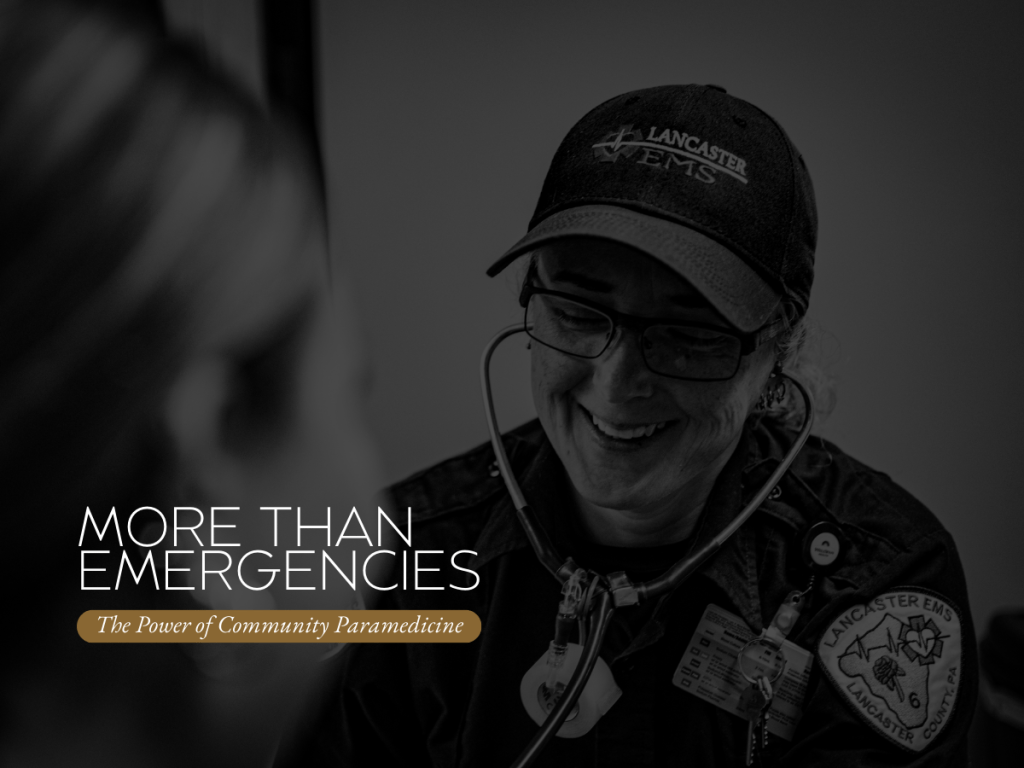
The Power of Community Paramedicine
“I don’t think I’m supposed to do this, but–”
I was sitting in a small white car cruising through the northern end of Lancaster county when the driver whipped the wheel back around. Her name was Erin, one of Lancaster EMS’ Community Paramedicine Providers, and as the Marketing Director, I was tasked with shadowing her shift in the hopes of getting some new photos for the program. We had just finished up with the second patient of the day when a phone call came: It was the first patient, Cecelia, a pregnant woman in her early 30s who had recently returned from a month’s long stay in an inpatient mental health facility. As a part of the protocol for behavioral health safe landings, the pair would meet once a week for a month after the patient’s release and, because of Ceclia’s health insurance plan, more if needed. We had spent the better part of the morning at her place. Upon leaving, Erin had scribbled her direct line on the back of a little white business card. “If you need anything,” she urged Cecelia, “call me.” Just a few hours later, she’d take Erin up on that offer.
Nodding her head along to the familiar voice on the other line, Erin checked the time: We had about an hour and a half before the next visit. Cecelia, who’d been experiencing abnormal cramping that morning, explained she just got off the phone with her primary care doctor and was told to go to the hospital. A lack of transportation and a strong fear of ambulances made that next to impossible. We happened to still be in the area, so with little hesitation, Erin turned the car around and in less than five minutes, we were back in front of Cecelia’s apartment. While every visit was a chance to cultivate compassion, “Some patients” Erin would later tell me reflecting on the unauthorized–and unscheduled–transport, “you just have a heart for them.”

It might come as a surprise that Lancaster EMS does more than emergencies. Even fewer would be aware of their Community Paramedicine (CP) Program. A good portion of the 9-1-1 calls Lancaster EMS receives don’t actually warrant a trip to the ER. These requests for service exasperate wait times, are costly and unproductively utilize vital resources. In the ambulance, EMTs and paramedics have a small window to tend to the issue at hand, an even less time to address mitigating the chance for readmission–this is where Community Paramedicine Providers step in.
First formed in 2016, Community Paramedic Providers meet you in your home or community setting to provide medical services, education, and care coordination. While safe landings make up the vast majority of visits, CP Providers also provide in-home blood work, lead screenings, wound care and immunizations. In addition, the CP Program works directly with unhoused individuals through Refresh Lancaster: a mobile shower unit and medical office launched in tandem with LanCo MyHome (Lancaster County Homeless Coalition).
In its first year, Lancaster EMS’ Community Paramedicine Program saw 99 patients. Today, they average about 700-800 a month.

While at the heart of Community Paramedicine lies prevention–a mission beneficial in all aspects (including financially) for both patients and healthcare providers–the one-on-one dynamic is also bringing intimacy back into medicine.
I grew up with a lieutenant colonel as a father. While a surprisingly gentle man, he took a ‘no nonsense’ approach to life–and I admired him for it. When the waters got rough during my teen years, however, I found myself swimming in circles in the name of self-reliance. My parents–who both came from modest backgrounds and worked their way up the socioeconomic ladder–often preached of the power of will. In my younger years, this led me to believe the world must be a place of ‘survival of the fittest’, and I wondered if I was cut out to make it on my own. Now in my 20s, I realize that’s not how we’re built to be at all. When I leapt into the ocean that is life, I was lucky enough to have floaties on. A lot of people are haphazardly tossed in having never even been taught how to swim, then judged and discounted for their inability to tread water.

When we first pulled up to Cecelia’s house that morning, she was on the phone with her primary care provider. On top of juggling a job, court dates and facing eviction, there was yet another mountain to climb: During her hospital stay, Cecelia was given medication that, thankfully, proved to work quite well. After being discharged however, she struggled to get her hands on a prescription, resulting in withdrawal. While Erin was setting up her laptop, the nurse on the other line asked Cecelia for an emergency contact. Barely holding back tears, she managed to get out, “I don’t have one.”
We know that people need food, housing, clothing, medical care–but people also need people. Community Paramedicine Providers, who function at the crosshairs of casework and healthcare, help bridge that gap. By the end of our initial meeting with Cecelia, Erin had set her up with counseling, food (courtesy of the Lancaster County Food Hub), transportation and started the process of looking for housing–and that was just the first visit of the day.

Lancaster is a county where charity and community reside as core values. This is reflected in the surplus of resources and nonprofits found throughout the area. But actually connecting the people who need those resources to them is often another journey in itself, and it’s not one that has to–or should–be walked alone. Community Paramedicine Providers, in addition to their own offer of medical care, are here to do just that.
When we saw Cecelia the second time that day, her demeanor was noticeably different from the first time around. She walked out donning a bright sundress with her hair and makeup done, and despite the circumstances, her head seemed to be lifted just a little bit higher. On the car ride to the hospital, the three of us made lighthearted conversation, joking about the weird decor on passing semis and the absurd summer heat. When we finally arrived and we watched Cecelia climb out of the little white car, it dawned on me that maybe Erin had given her a special kind of medicine that wasn’t exactly in her kit that day: hope.

Erin Wiegand
Community Paramedicine Provider
 Community Paramedicine Program
Leave a comment